

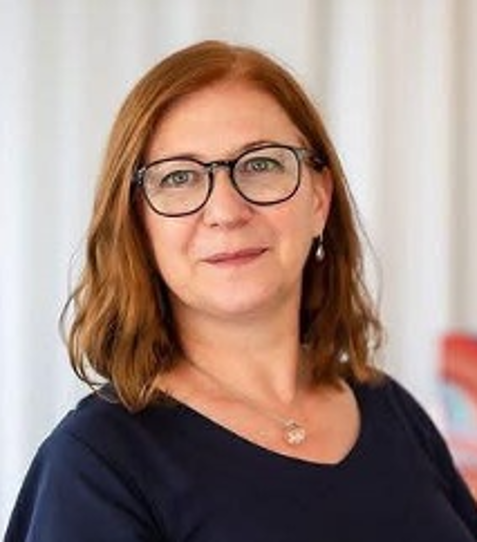
Székely Annamária
The central theme of my painting is space and the layering, and the constant restructuring of space. The starting point is something real, recognisable for anyone, a district of the city, a section of a street, buildings, building complexes, or fragments, imprints of the architectural environment. For me, these locations are not scenes to be documented, rather systems in which reality and vision are projected onto each other. The spaces frequently manifesting in my paintings reach the viewer indirectly, through a distinctive filter: reflexion. Reflexion simultaneously distorts and enriches the image, as the depicted street fragments are complemented by the glimpse of the interior spaces behind the glass, thus, new spatial relationships emerge forming new, non-existent yet recognisable spatial relations.
The resulting image becomes a mapping of multiple visual realities, a layered optical and semantic superimposition.
Reflection is not a mere instrument for me, but a philosophical metaphor of seeing, which reminds us that space itself is constructed from fragments and reflections that reaches us through a mediated way. Being mediated signifies a creative force in my painting, a filter that creates new structures where reality and image meet.
My artistic approach towards urban spaces is not a simple matter of depiction, but an examination of the deeper nature of perception. My pictures, stemming from fragments of real spaces, are not copies of the scenery, but distinctive models of experiencing the space. From this perspective space is not understood as a physical attribute, but rather as a layered field of perception and meaning, in line with the phenomenological thought of Edmund Husserl (1859-1938) and Maurice Merleau-Ponty (1908-1961). Viewpoint, bodily position, and the focus of attention are all factors that actively shape what we experience as space. Therefore, the role of reflection becomes crucial: the image reflected and transformed by surfaces enters a specific mediated condition in which reality no longer appears as a single, stable entity, but as a multiplicity of overlapping layers, fragments, and traces of light. Thus, the reflective motif emerges as a visual metaphor for the formation of vision, demonstrating that the gaze does not grasp the world immediately, but always unfolds within a constructed and mediated spatial field.
Martin Heidegger’s philosophy further refines this conceptual framework. The built environment is not merely the setting of human existence, but a condition of being-in-the-world itself; streets and buildings carry the traces of dwelling, points at which existence reveals itself. The urban details that my painting highlights and transforms into autonomous visual images are, in fact, condensations of these traces. The fragments simultaneously refer to the absent whole and the subjective character of experience, affirming that the city is not an abstract space but a lived place. Within the paintings, the urban image functions as a subjective document—a “trace of being”— in which the concealed relations between landscape and human presence come to the surface. Reflection, in this context, is no longer a mere optical phenomenon, but a mode of disclosure through which the world is displaced from its habitual position and reveals previously hidden aspects of itself.
Jean Baudrillard (1929-2007) sociologist and philosopher’s concept of the simulacrum further deepens my understanding of reflection. Reflection is not a faithful copy of the original view, but a new visual entity structured according to its own internal logic. The image produced by the surface detaches from its source and becomes a version of reality that is simultaneously familiar and estranged. Through reflection, the urban fragment is no longer itself, but an alternative, filtered, and displaced version, a form of “mirror-being” in which physical space and its reflection mutually exclude and complete one another. In my paintings, this duality coheres into an autonomous reality: reflection becomes an independent form of the image, capable of regeneration and transformation.
These three conceptual horizons, phenomenological perception, Heidegger’s concept of being-in-the-world, and the postmodern notion of the simulacrum, converge within my painting practice. The fragmentary nature of the city, the vision filtered through surfaces, and reflection as a displacing element all point to space as a constantly shifting experience and structure. The spaces that emerge in my paintings are therefore not reproductions, but visual imprints of transitions between seeing and being—zones where reality changes surface and reconfigures itself through reflection.
Within the history of painting, trompe-l’oeil has functioned as an exploration of the limits of perception, creating the illusion of space against the flatness of the picture plane, while the viewer’s bodily presence activates the visual experience. Phenomenology, particularly the thought of Maurice Merleau-Ponty, emphasises that spatial perception is inseparable from corporeality; trompe-l’oeil thus exceeds the status of an optical trick and instead carries a philosophical interrogation of perception itself.
In my earlier works, I approached this phenomenon through the illusionistic “stepping out” of the image: spatial depth was generated by the painted illusion itself. In my more recent works, however, the concept is reversed: the physical support of the painting steps out of the plane; the surface itself becomes three-dimensional. Yet, from a specific vantage point, the composition still appears flat, as though the protruding form had no actual extension. Painted perspective thus proves stronger than material reality, and illusion conceals the corporeality of the support.
This duality creates a new perspective at the threshold between painting and sculpture. In contrast to the minimalist “specific object” tradition associated with Donald Judd, my works preserve both the illusionistic and the object-like nature of the artwork. The three-dimensional picture plane acquires an architectural scene while depicting urban motifs; thus, the painting does not merely depicts, it inscribes itself into space. Simultaneously, the painting shifts from stasis into a perceptual event generated by the viewer’s movement, changing viewpoints, and moments of recognition. Real space and apparent space fuse and diverge again, generating a postmodern simulacrum-like condition, in which illusion and reality transform from opposites into each other’s possibilities.
The spatial extension of the picture plane is thus both an artistic and philosophical experiment, and an inquiry into how the act of seeing constructs space, and how a painting may become an experience that exceeds its own materiality.
A significant strand of my artistic practice consists of series that also originate from real environment, yet mediate the image not through traditional perspective but through 3D visualization. Using red–blue anaglyph technique, spatial experience arises from the viewer’s active participation — from perception through red–blue glasses. This form of “technical mediation” is a key concept of the phenomenological approach: space as such is not simply given; it is constituted in the act of perception.
Here, the fundamental element of painting, colour, becomes the primary constructive agent. The 3D effect does not stem from sculptural modelling but from the juxtaposition, vibration, and displacement of colours. The vivid, intense chromatic range of the compositions creates a paradoxical effect: full spatial immersion ultimately unfolds through the reduced colour spectrum perceived through the lenses. The painting thus operates simultaneously as sensory-spatial experience and as optical construction.
For me, this technique represents an expansion of the boundaries of painting, whereby the cityscape becomes not merely a represented object but a site of vision itself. The 3D paintings are grounded in the viewer’s position and colour-activated illusion, and in the recognition that spatial experience always exceeds what is visible on the surface of the image. The painting does not only depict space, but actively generates it, producing a perceptual event that emerges from the interaction of colour, technique, and perception.
Reflection, particularly through shop windows, is not merely a visual effect, it is closely tied to modern urban and consumer society. These surfaces mirror their surroundings while simultaneously displaying trends, fashion, and the dynamism of everyday life. Reflections therefore function as both perceptual and social commentary. Urban space thus appears not only as visual fragment but as an imprint of social habits and contemporary culture. Reflective surfaces intertwine layers of reality and consumer representation, while painting’s fundamental tools, colour, form, and perspective activate the viewer.
Overall, my works investigate the limits of painting: the picture plane, spatial experience, chromatic play, and the role of the viewer’s perception. Urban spaces, buildings, and reflective surfaces are not merely depicted fragments but perceptual and social events. The protruding, 3D, and reflective images all aim to ensure that space becomes not only visual information but also lived experience. The painting thus moves beyond its objecthood and becomes an encounter of vision, colour, space, and social reflection in which reality, illusion, and materiality interconnect.